Lakshmi Puja Vidhi at Home: Step-by-Step Guide with Samagri List (Diwali 2026)
By DevPravas Editorial Team · · 6 min read
Every Diwali evening, in kitchens from Pune to Pittsburgh, someone is standing over a half-packed thali and asking the same thing: "Did we forget the betel nut? Which comes first, Lakshmi or Ganesh?" Nobody is doing it wrong. Most of us learned the Lakshmi puja vidhi at home by watching an older relative, and that knowledge rarely gets written down. So here it is, written down: what to gather, what order to follow, and what to say, for Diwali 2026.
Families differ in details by region, community and lineage, so treat this as a widely followed outline, and let your family's own practice or your family pandit's guidance take precedence.
When to Do Lakshmi Puja on Diwali 2026
The main Lakshmi Puja falls on the evening of Sunday, 8 November 2026, during Pradosh Kaal after sunset. The exact window depends on your city. For Delhi, Mumbai, New York and London timings, see Diwali 2026 Date and Muhurat, and for what each of the five days means, read Diwali 2026: The Five Days, Explained. Plan to be ready, with everything laid out, about 30 minutes before the muhurat begins.
Lakshmi Puja Samagri List
Gather everything before you sit down, because getting up mid-puja breaks the flow. A typical Lakshmi puja samagri list looks like this:
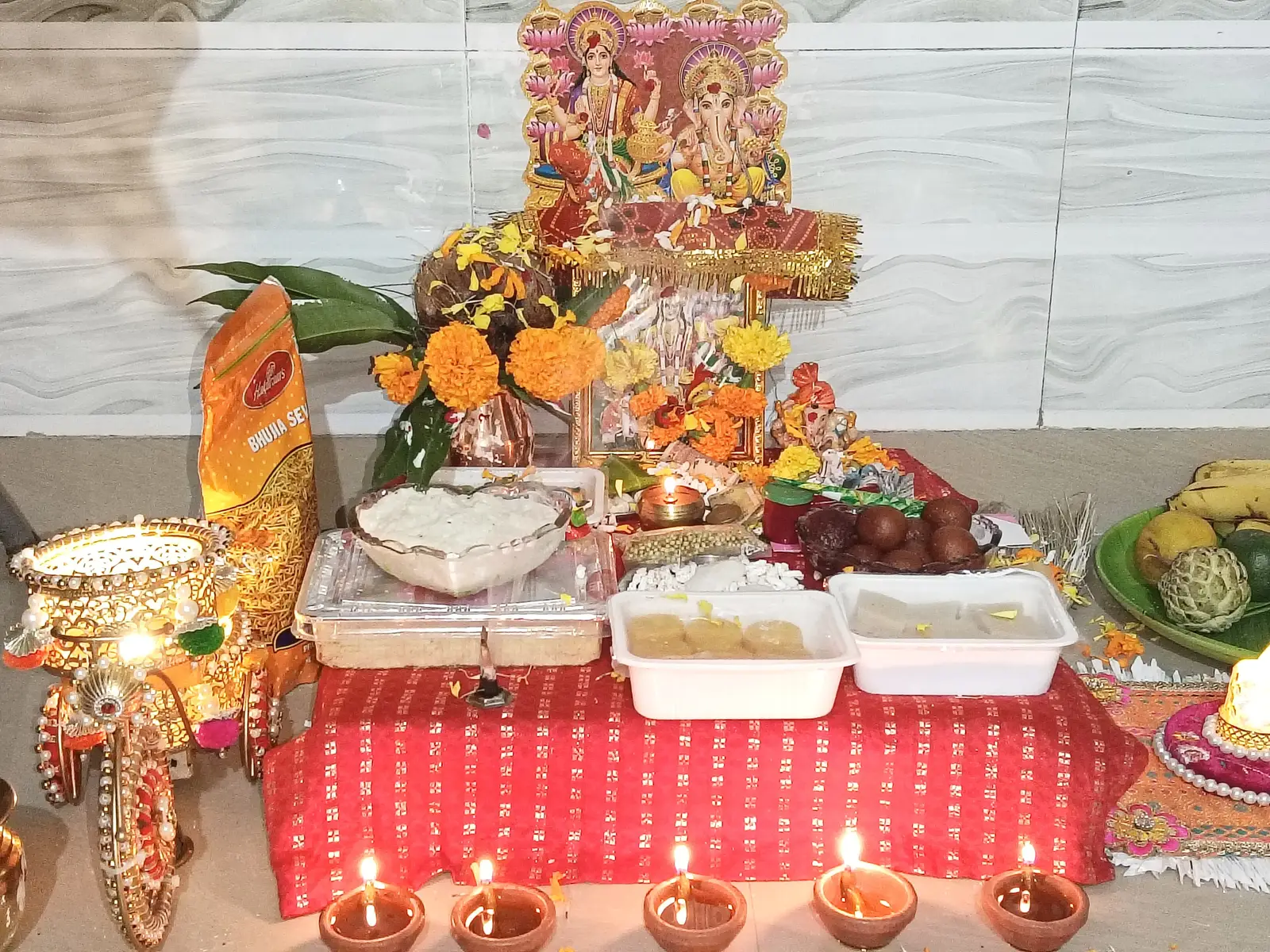
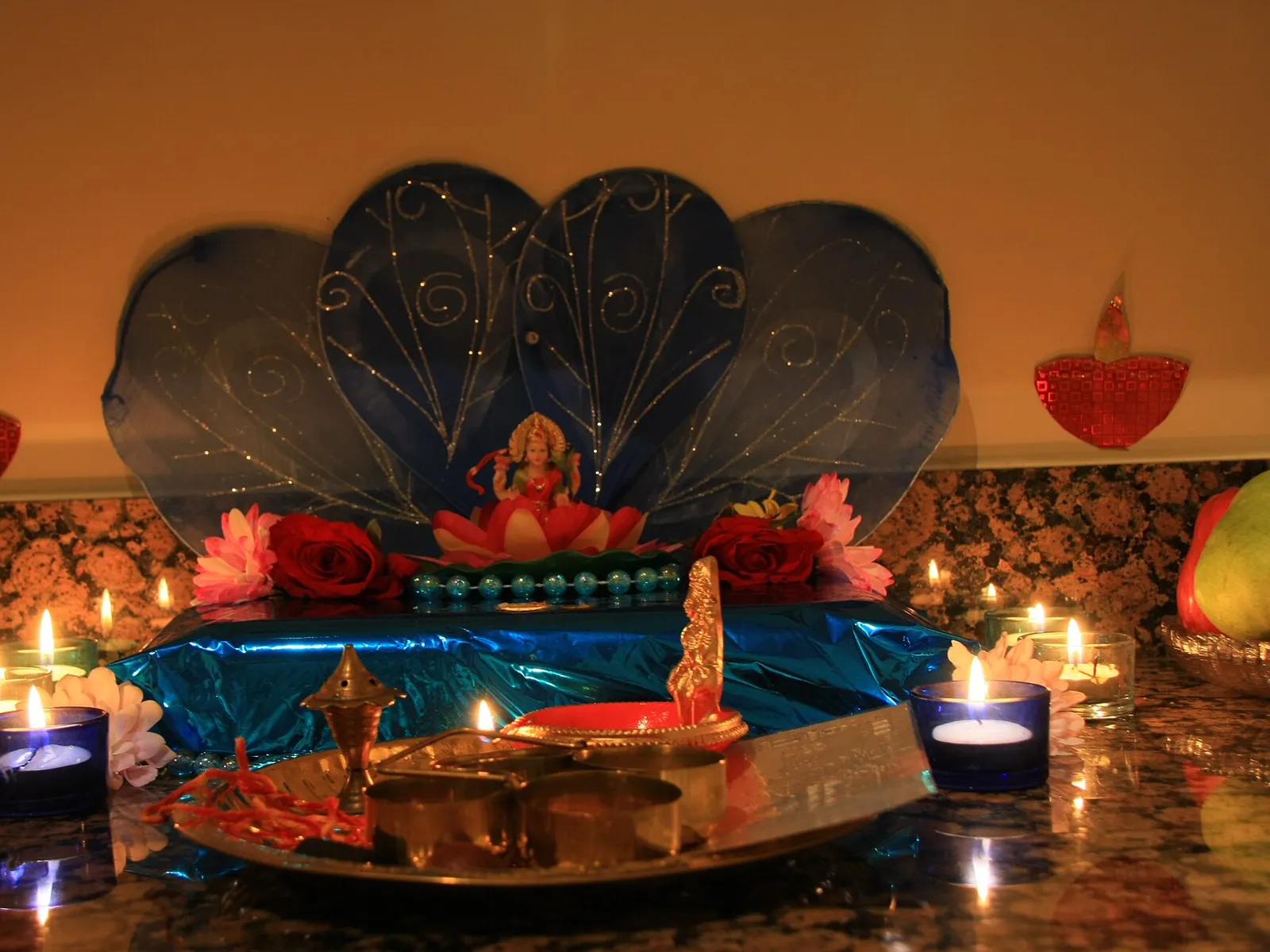
- Deities: an image or idol of Lakshmi and Ganesh (a framed picture is perfectly fine), and a small seat or chowki with a red or yellow cloth.
- Kalash: a pot of water with mango leaves around the mouth and a coconut on top.
- Puja thali items: roli (kumkum), haldi, akshat (unbroken rice), sandalwood paste, mauli (red thread), and a little camphor.
- Flowers and leaves: marigolds, a lotus if you can find one, and fresh mango or betel leaves.
- Offerings (naivedya): sweets such as laddoo or kheer, fruit, batasha, dry fruit, and sugar candy or puffed rice.
- Lamps and incense: a ghee or oil diya for the altar, a row of diyas for the home, incense sticks and a bell.
- Coins and valuables: a few coins, some currency notes, and any jewellery you traditionally place before Lakshmi. Business families add their account books or cash box.
- Others: a small bowl of water and spoon for achaman, a plate for the puja, and a clean cloth.
None of this needs to be expensive. If an item is hard to find abroad, use the nearest substitute - a candle-style diya, or any fresh flower - and carry on. The intention matters more than a perfect inventory.
Lakshmi Puja Vidhi: Step-by-Step Order
This is the usual sequence for a Diwali Lakshmi-Ganesh puja at home:
- Prepare the space. Clean the home, draw a rangoli at the entrance and light diyas at the door and windows. Bathe and wear fresh, preferably traditional, clothes.
- Set the altar. Spread the cloth on the chowki, place Ganesh on the left and Lakshmi on the right of the kalash, facing east or north if possible.
- Sankalp. Hold a little water and rice in your right hand, state your name, your family's gotra if you know it, the date and your intention for the puja, then release the water.
- Worship Ganesh first. Ganesh is always invoked before any other deity. Offer roli, akshat, flowers and a little sweet, with the mantra "Om Gam Ganapataye Namah."
- Invoke the kalash. Touch the kalash with roli and mauli, and invite the presence of the gods and the sacred rivers into the water.
- Invoke Lakshmi (avahan). Welcome Lakshmi with folded hands, offer her an asan, then offer water for washing the feet and mouth. Many families bathe the idol with water, milk, curd, honey and ghee (panchamrit), then clean water, before dressing her in new cloth.
- Offerings. Offer roli, haldi, akshat, flowers, a garland, incense and the diya, then the naivedya. Offer coins and the account books or valuables on the altar.
- Chant. The most commonly used mantra is "Om Shreem Mahalakshmyai Namah" - chant it 108 times if you have a mala, or as many times as you comfortably can. Reading the Shri Suktam or the Lakshmi Chalisa is a lovely addition if your family does so.
- Aarti. Wave the lit aarti diya in a clockwise circle and sing "Om Jai Lakshmi Mata" with the family, ringing the bell.
- Prarthana and prasad. Fold your hands and pray for the wellbeing of the family. Distribute the prasad to everyone present, and to neighbours the next morning.
After the puja, keep one diya burning through the night if it is safe to do so, and, if your family follows the custom, keep the main door open for a little while to welcome Lakshmi. The altar items can stay until the next morning.
Common Mistakes to Avoid
- Starting without Ganesh. Ganesh worship comes first, every time.
- Skipping the sankalp. The statement of intention is what makes the puja yours.
- Rushing. A household Lakshmi Puja typically takes 30 to 60 minutes. A calm half-hour is better than a hurried five minutes.
- Stressing about a missing item. A sincere, simple puja is complete. Don't let a lost thali or a missing lotus ruin the evening.
What If You Can't Do It at Home?
Some Diwalis don't allow for a home puja: your pandit is booked all week, you're travelling, you've just moved, or you live far from family. For those households, the DevPravas Laxmi Puja is a Lakshmi-Ganesh puja performed by a pandit in the auspicious evening muhurat, joined live by video call. For the day before, there is also a Dhanteras Puja. You can browse every ceremony in the puja catalog, and families abroad can see how timing works on our NRI page.
FAQ: Lakshmi Puja at Home
What is the Lakshmi puja vidhi at home?
In short: prepare the space and altar, take the sankalp, worship Ganesh first, invoke the kalash, then invoke and worship Lakshmi with offerings, chant the Lakshmi mantra, perform the aarti, and distribute prasad. The sequence above is the commonly followed order; your family's tradition may differ in small ways.
What is needed for Lakshmi puja at home?
You need images or idols of Lakshmi and Ganesh, a kalash with a coconut and mango leaves, roli, haldi, akshat, flowers, sweets and fruit, diyas, incense, camphor, coins and a puja thali. A full list is in the samagri section above. Substitutes are fine if something is hard to find.
Which mantra should I chant for Lakshmi puja?
"Om Shreem Mahalakshmyai Namah" is the most widely used Lakshmi mantra, and "Om Gam Ganapataye Namah" is used for Ganesh. Many families also recite the Shri Suktam or sing the Lakshmi aarti. Use what your family already follows.
How long does Lakshmi puja take?
Usually 30 to 60 minutes at home, depending on how many mantras and prayers you include. See Diwali 2026 Date and Muhurat for the timing in your city.
Can I do Lakshmi puja if I live abroad?
Yes. Families in the USA, UK, Canada and the Gulf perform it at home each year, with the muhurat worked out for their own city. If you can't do it yourself, you can book a live Lakshmi Puja through devpravas.in.
Related Reading
If you're planning Diwali from outside India, Your 30-Day Diwali 2026 Planning Guide for NRIs offers a day-by-day plan, and our Hindu Festival Calendar 2026 shows how Diwali fits into the rest of the year.
Book Your Diwali Puja
Whether you're doing Lakshmi Puja in your own living room or joining one live from far away, the main thing is to begin with a calm mind and a clean, well-lit home. Message us on WhatsApp to confirm your city's timing and arrange a puja in your family's name, or book directly at book.html.
Share this article
Found this useful? Pass it on to a family member who is weighing the same question.